Parallel Circuits Explained Simply | Voltage, Current & Resistance
Watch the Video:
What You’ll Learn:
• How parallel circuits are different from series circuits
• Why voltage is the same across each branch
• How current splits in parallel paths
• How to calculate branch currents and total current
What Is a Parallel Circuit?
A parallel circuit is a circuit where components are connected across the same two nodes.
This means each component has its own path to the power source.
Differences between a series and parallel circuit:
In a series circuit, voltage changes with resistance but current stays the same.
In a parallel circuit, current can split and flow through multiple paths at the same time but voltage across the resistors stay the same.
Series circuit: Voltage changes with resistance. Current is the same at any point in the circuit.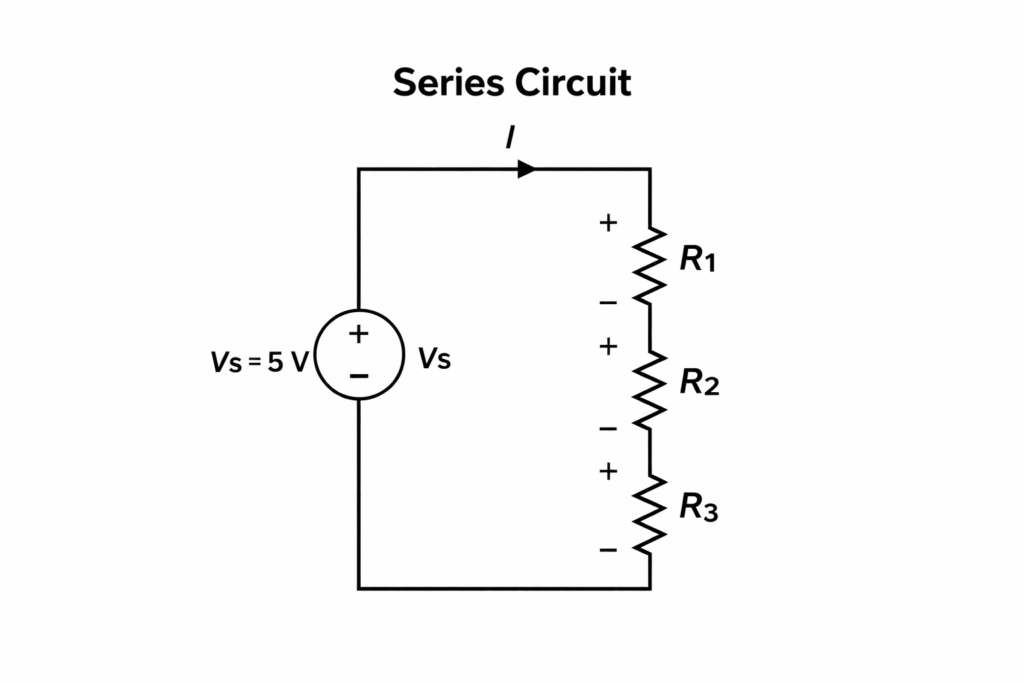
Parallel circuit: Voltage across the resistors stay the same but the current divides into different branches.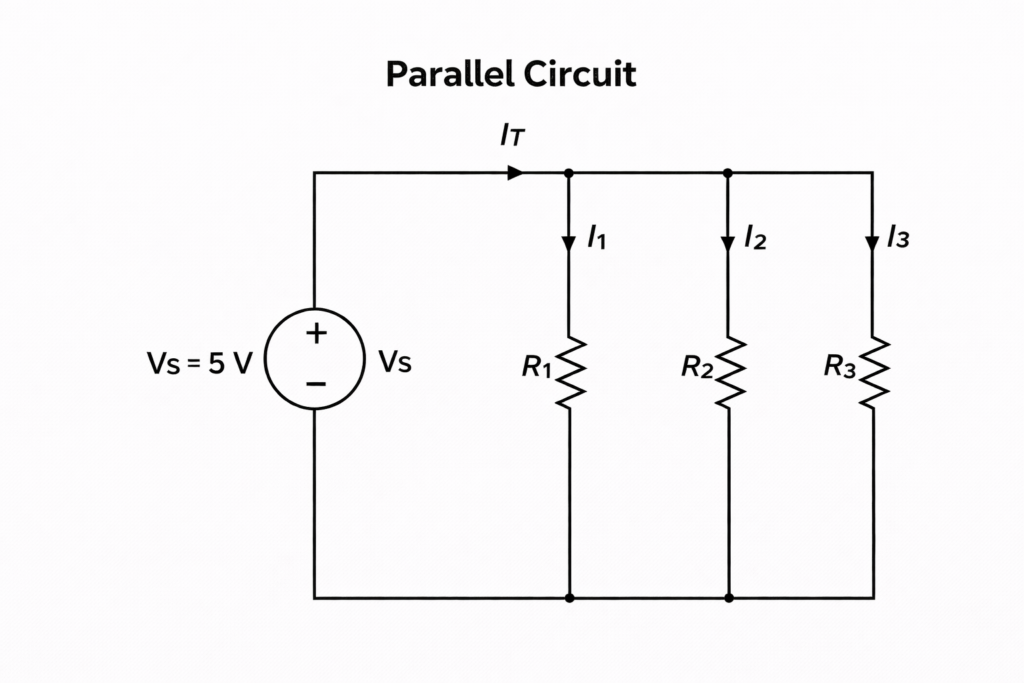
Key Rule of Parallel Circuits
In a parallel circuit, the voltage across every branch is equal to the source voltage.
For this lesson:
VS = 5 V
So:
VR1 = 5 V
VR2 = 5 V
VR3 = 5 V
Our Example Circuit
• Supply voltage = 5 V
• R1 = 220 Ω
• R2 = 470 Ω
• R3 = 1 kΩ
Each resistor is connected in parallel.
Step-by-Step Calculations
1) Current through R1
Using Ohm’s Law:
I1 = V / R1
I1 = 5 V / 220 Ω
I1 ≈ 22.7 mA
2) Current through R2
I2=V/R2
I2 = 5 V / 470 Ω
I2 ≈ 10.6 mA
3) Current through R3
I3=V/R3
I3 = 5 V / 1000 Ω
I3 = 5 mA
4) Total Current from the Source
In a parallel circuit, currents add together:
I Total or IT = I1 + I2 + I3
IT = 22.7 mA + 10.6 mA + 5 mA
IT ≈ 38.3 mA
Kirchhoff’s Current Law Check (KCL)
Kirchhoff’s Current Law states that the total current entering a node must equal the total current leaving it.
The source current splits into the three branches, and the sum of the branch currents equals the source current.
This confirms our calculations are correct.
Checking Our Work Using Total Resistance
Now let’s calculate the total resistance of the parallel network and use it to find the total current from the source.
This gives us a second way to verify our earlier answer using Kirchhoff’s Current Law.
Step 1: Use the Parallel Resistance Equation
For resistors in parallel:
1 / R_total = 1 / R1 + 1 / R2 + 1 / R3
Substitute the values:
1 / R_total = 1/220 + 1/470 + 1/1000
Convert to decimals:
1 / R_total ≈ 0.004545 + 0.002128 + 0.001
1 / R_total ≈ 0.007673
Now invert to find total resistance:
R_total ≈ 130 Ω
Step 2: Use Ohm’s Law with the Source Voltage
Now calculate total current from the source:
I_total = V / R_total
I_total = 5 V / 130 Ω
I_total ≈ 0.0385 A = 38.5 mA
Step 3: Compare to Kirchhoff’s Current Law Result
Earlier, we added the branch currents:
I_total ≈ 38.3 mA
This matches very closely (small differences are from rounding).
This confirms both methods are correct:
• Using branch currents and KCL
• Using total resistance and Ohm’s Law
Both lead to the same answer!
Finding the Smallest Resistor for a ¼-Watt Rating
The resistors I have are ¼-Watt Rating. So we want to prevent them from overheting and burning out.
We use the power formula:
P = V² / R
Solve for R:
R = V² / P
Plug in your values
V = 5 V
P = 0.25 W
R = 5² / 0.25
R = 25 / 0.25
R = 100 Ω
Result
The smallest resistor that can safely dissipate 0.25 W at 5 V is:
100 Ω
Any resistor smaller than 100 Ω would exceed the ¼-watt rating and could overheat. So, to add more safety I would pick a resistor around 150 Ω. This adds a 50% safety tolerance. The smallest single resistor I had was 220 Ω so we were very safe in this circuit.
Lesson Learned
• Every branch receives the full 5 V
• Lower resistance branches draw more current
• Adding parallel branches increases total current
• Parallel circuits are used when components must operate independently
Method 1 — Branch Currents (Kirchhoff’s Current Law)
Calculate the current in each branch using Ohm’s Law, then add them together to get the total current.
Method 2 — Total Resistance First
Use the parallel resistance equation to find the total resistance, then use Ohm’s Law with the source voltage to find the total current.
Both methods should give the same result. If they don’t match, it usually means a calculation error somewhere. Using both approaches is a great way to check your work and build confidence in your answers.
Common Beginner Mistakes
• Thinking voltage divides in parallel circuits
• Forgetting currents add together
• Assuming all branches carry equal current
• Confusing series and parallel layouts on a breadboard
Try This Yourself
Build the circuit using:
• 5 V supply
• 220 Ω resistor
• 470 Ω resistor
• 1 kΩ resistor
Measure the voltage across each resistor.
You should see about 5 V on every branch.
Then measure the current in each branch and compare it to the calculations.
Prefer video?
Watch full lessons on the Build Circuits With Rich YouTube Channel.
Back To: Videos